

Other
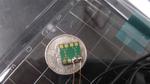
“Studying how to make and combine cutting-edge materials is leading to cheaper, more efficient, and more sensitive gaseous sensors. The human nose can distinguish among a trillion different combinations of smells. Even so, there are plenty of gases that our …

“An Oak Ridge National Laboratory method to improve the energy efficiency of scientific artificial intelligence is showing early promise in efforts to parse insights from volumes of cancer data. Researchers are realizing the potential of deep learning to rapidly advance …
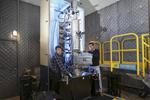
“A scientific team led by the Department of Energy’s Oak Ridge National Laboratory has found a new way to take the local temperature of a material from an area about a billionth of a meter wide, or approximately 100 …
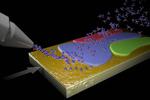
“A new method to produce large, monolayer single-crystal-like graphene films more than a foot long relies on harnessing a “survival of the fittest” competition among crystals. The novel technique, developed by a team led by the Department of Energy’s …

“A team of researchers led by the Department of Energy’s Oak Ridge National Laboratory has demonstrated a new method for splitting light beams into their frequency modes. The scientists can then choose the frequencies they want to work with …
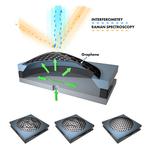
“Crumpling reduces rigidity in an otherwise stiff material, making it less prone to catastrophic failure. The Science Gas pressure was applied to a crumpled graphene membrane to cause it to bulge and stiffen. The result? The gas pressure revealed that …
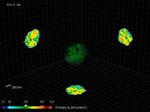
“The Big Bang began the formation and organization of the matter that makes up ourselves and our world. Nearly 14 billion years later, nuclear physicists at the Department of Energy’s Oak Ridge National Laboratory (ORNL) and their partners are …

“After more than a year of operation at the Department of Energy’s (DOE’s) Oak Ridge National Laboratory (ORNL), the COHERENT experiment, using the world’s smallest neutrino detector, has found a big fingerprint of the elusive, electrically neutral …
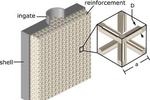
“A new manufacturing method created by Oak Ridge National Laboratory and Rice University combines 3D printing with traditional casting to produce damage-tolerant components composed of multiple materials. Composite components made by pouring an aluminum alloy over a printed steel lattice …
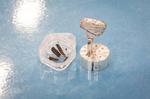
“A team led by the Department of Energy’s Oak Ridge National Laboratory has used sophisticated neutron scattering techniques to detect an elusive quantum state known as the Higgs amplitude mode in a two-dimensional material. The Higgs amplitude mode is …