

Other
“Recently the internet noticed the Raspberry Pi could drive LCD panels using DPI. This allows very inexpensive displays to be used with basically no additional hardware. In this post we dive into the hardware required, the software configuration, how to …
“In this tutorial, I’ll show you how you can make DIY Piano by connecting IC555 timer in ASTABLE multivibrator Mode with variable frequency to a speaker. The piano is a wonderful musical instrument and one can make a cheap …

“We are pleased to announce the Mbed OS 5.13.3 release is now available. This is the latest patch release based on the feature set that Mbed OS 5.13 introduces. Summary In this release we have added the …
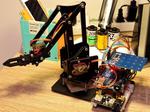
“Instead of using 2-axis joysticks, I decided to use a spare TTP229-BSF capacitive touchpad to control a 4-DoF MeArm robotic arm. After returning the MeArm I borrowed from my former company, I wanted to build one for my own …
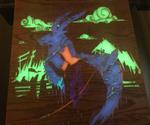
“I wanted to make an art piece for coffee table that glowed as I sipped my morning coffee or my evening tea. The issue in this is that I am an engineer, not an artist. Though, because I am an …
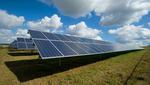
“Transparent electrodes are a critical component of solar cells and electronic displays. To collect electricity in a solar cell or inject electricity for a display, you need a conductive contact, like a metal, but you also need to be able …
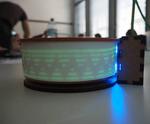
“Do you wonder how to write text with LEDs? In this workshop well show you how to do this and use UV LEDs to write a text or images on a phosphorescent surface. The photonics principles used are light absorption …

“This robot has been a dream robot for me to build for a long time. Before diving into how to build this robot, let me give a quick overview of what this robot is capable of! You can ask the …

“Recent advances of research on the application of photovoltaic technologies for self-powering of neuromorphic devices are reported in a detailed review by Dr Amador Pérez-Tomás, of the ICN2 Oxide Nanophysics group, which has been just published in Advanced Materials Interfaces …
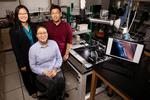
“Researchers have found a way to use polymer printing to stretch and flatten twisted molecules so that they conduct electricity better. A team led by chemical and biomolecular engineers from the University of Illinois report their findings in the journal …