

Other
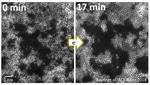
“Atomically thin crystals will play an ever greater role in future – but how can their crystallisation process be controlled? A new method is now opening up new possibilities. They are among the thinnest structures on earth: “two dimensional materials” are …
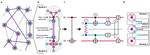
“Yale University researchers have demonstrated one of the key steps in building the architecture for modular quantum computers: the “teleportation” of a quantum gate between two qubits, on demand. The findings appear online Sept. 5 in the journal Nature. The …

“Researchers from Duke University are teaming up with colleagues at the University of Washington and industry experts at Northrop Grumman to develop metamaterial antennas tailored to the contours and angles of modern military aircraft. The collaboration is the result of …

“Unmodified optical fibers actively interact with components of biological media that literally deposit on their surface and thus do not allow them to function. Due to the effect of surface plasmon resonance and iodonium salts scientists grafted a very thin …
“The effect has been predicted theoretically decades ago - but it is very hard to provide experimental evidence for it: “Superradiance” is the phenomenon of one atom giving off energy in the form of light and causing a large number of …
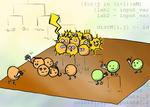
“The table groups molecules according to the nano-shapes they form The approach was developed by Daniel Packwood of Kyoto University’s Institute for Integrated Cell-Material Sciences (iCeMS) and Taro Hitosugi of the Tokyo Institute of Technology. It involves connecting the …
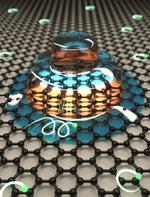
“In a marriage of quantum science and solid-state physics, researchers at the National Institute of Standards and Technology (NIST) have used magnetic fields to confine groups of electrons to a series of concentric rings within graphene, a single layer of …

“Researchers at University of Jyväskylä (Finland) and University of Tampere (Finland) together with BioNavis Ltd (Finland) have developed a novel nanoactuator system, where conformation of biomolecule can be tuned by electric field and probed using optical properties of gold nanoparticle …
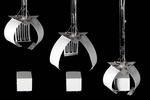
“One of the oldest, most versatile and inexpensive of materials — paper — seemingly springs to life, bending, folding or flattening itself, by means of a low-cost actuation technology developed at Carnegie Mellon University’s Human-Computer Interaction Institute. A thin layer of …
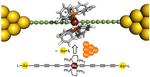
“Scientists at Tokyo Institute of Technology designed a new type of molecular wire doped with organometallic ruthenium to achieve unprecedentedly higher conductance than earlier molecular wires. The origin of high conductance in these wires is fundamentally different from similar molecular …