

Other
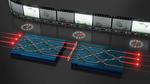
“It seems quantum mechanics and thermodynamics cannot be true simultaneously. In a new publication, UT researchers use photons in an optical chip to demonstrate how both theories can be true at the same time. They recently published their results in …
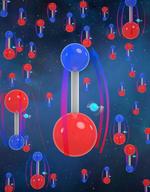
“In the first moments of our universe, countless numbers of protons, neutrons and electrons formed alongside their antimatter counterparts. As the universe expanded and cooled, almost all these matter and antimatter particles met and annihilated each other, leaving only photons …
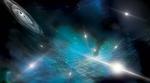
“Scientists have found evidence of a universal background of gravitational waves, or ripples in the fabric of space-time. The motion of black holes and other massive objects through space can create ripples in the fabric of the universe, called gravitational …
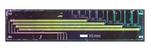
“Device protects optical systems from unwanted reflections with dramatically enhanced performance. An optical isolator developed at the Harvard John A. Paulson School of Engineering and Applied Sciences (SEAS) could drastically improve optical systems for many practical applications. All optical systems …
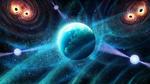
“Precise as a clock: pulsars in the Milky Way form large-scale observatory for gravitational waves Astronomical observatories are usually based on Earth and study the extreme processes in the universe by capturing light as an information carrier. But not all …
“AMD (NASDAQ: AMD) today announced the AMD Versal™ Premium VP1902 adaptive system-on-chip (SoC), the world’s largest1 adaptive SoC. The VP1902 adaptive SoC is an emulation-class, chiplet-based device designed to streamline the verification of increasingly complex semiconductor designs. Offering 2X2 …
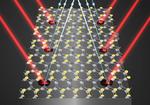
“New technique for implanting defects could be scalable for quantum technologies A new approach to manufacture quantum defects in semiconductors presents a way to better employ those defects as quantum light emitters, a light source emitting a stream of photons …
News Astronomers find first evidence for new class of gravitational waves which could unveil origin of the Universe
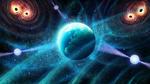
“After 25 years of observations, an international team of astronomers has seen the first evidence of ultra-low-frequency gravitational waves. The waves are expected to come from pairs of supermassive black holes found in the centres of merging galaxies and the …
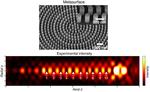
“Optical devices and materials allow scientists and engineers to harness light for research and real-world applications, like sensing and microscopy. Federico Capasso’s group at the Harvard John A. Paulson School of Engineering Applied Sciences (SEAS) has dedicated years to …
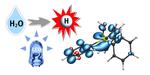
“A team headed by Münster University chemist Prof Armido Studer has developed a photocatalytic process in which water is activated using an oxidised triaryl phosphine as a reagent. Activation is a precondition for splitting water into its components. Hydrogen is …