

Other

“Breakthrough could lead to high-speed, low-power nanoscale data storage Ever since graphene – a thin carbon sheet just one-atom thick – was discovered more than 15 years ago, the wonder material became a workhorse in materials science research. From this body of …
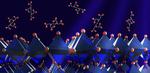
“Researchers have developed a method to stabilise a promising material known as perovskite for cheap solar cells, without compromising its near-perfect performance. The researchers, from the University of Cambridge, used an organic molecule as a ‘template’ to guide perovskite films …

“When fully operational, Hornsea 2’s 165 8 MW Siemens Gamesa wind turbines will be capable of generating 1.32 GW of clean electricity – taking the title of ‘world’s largest operating offshore wind farm’ from its sibling project Hornsea …
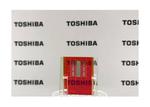
“A boost to development of no-plug charging EVs and transition to renewable energy. Toshiba Corporation (TOKYO: 6502) today announced that it has successfully raised the power conversion efficiency (PCE) of its transparent Cu2O solar cell to 8.4%, the world …
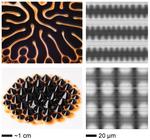
“An electric field transforms an iron oxide nanoparticle suspension into a model for the emergence of complex dissipative structures Researchers at Aalto University have shown that a nanoparticle suspension can serve as a simple model for studying the formation of …
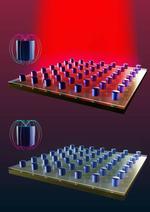
“Controlling nanolasers with magnets lays the groundwork for more robust optical signalling. A magnetic field can be used to switch nanolasers on and off, shows new research from Aalto University. The physics underlying this discovery paves the way for the …

“Engineers at West Virginia University are propelling exploration forward by creating control software for a group of aerial robots (aerobots) that will survey the atmosphere of Venus, the second planet from the sun. According to researchers, Venus went through a …
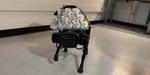
“USC Viterbi researchers help four-legged robots carry heavy packages to spaces unknown. Increased package deliveries, especially in pandemic times, can put an undue stress on mail carriers and warehouse workers. But what if they could get help from some four-legged …
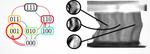
“A piece of corrugated rubber can function as a simple computer, displaying memory and displaying the ability to count to two. Leiden physicists describe the computing rubber in the journal PNAS. ‘Simple materials can process information, and we want to …
News A versatile set of detector building blocks prepares SLAC researchers for a challenging future of X-ray science
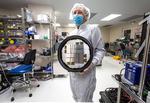
“The ePix series of detectors is designed to keep pace with ever more demanding experiments at SLAC and elsewhere. When the Department of Energy’s SLAC National Accelerator Laboratory turned on the world’s first hard X-ray free-electron laser in …