

Other
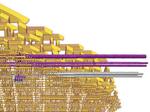
“A team of researchers based in Switzerland is on the way to laying bare much of the secret technology inside commercial processors. They pointed a beam of X-rays at a piece of an Intel processor and were able to reconstruct …
News As Moore’s law nears its physical limits, a new generation of brain-like computers comes of age in a Stanford lab

“For five decades, Moore’s law held up pretty well: Roughly every two years, the number of transistors one could fit on a chip doubled, all while costs steadily declined. Today, however, transistors and other electronic components are so small …
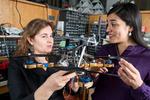
“Distributed planning, communication, and control algorithms for autonomous robots make up a major area of research in computer science. But in the literature on multirobot systems, security has gotten relatively short shrift. In the latest issue of the journal Autonomous …
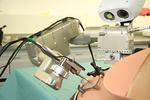
“A team of surgeons and engineers of Inselspital, Bern University Hospital, and the ARTORG Center for Biomedical Engineering Research, University of Bern (Switzerland), have developed a high-precision surgical robot for cochlear implantation. In the same way that avionics allow a …
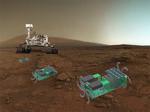
“PUFFER is an origami-inspired robot concept that would provide future NASA missions with simple, low-cost access to new high-value extreme terrains. Example terrains could include caves and lava tubes on Mars, or icy “chaos terrains” on the surface of Europa …

“IT’S an absolute. Mathematics has put speed limits on cooling, finally proving a century-old law – that unless you have infinite time and resources, you can’t get to the absolute zero of temperature. In 1906, German chemist Walther Nernst …

“Emerging supercomputer maker ExaScaler Inc. and Keio University are among those developing an original supercomputer. Their project is supported by a Japan Science and Technology Agency program that provides subsidies of up to ¥5 billion for promising technologies. The corporate-academic …

“Will artificial intelligence (AI) change the nature of work? For EPFL theoretical biologist Marcel Salathé, the answer is invariably yes. To him, a more fundamental question that needs to be addressed is who owns that artificial intelligence? “We have to …
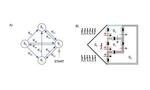
“Scientists have built tiny logic machines out of single atoms that operate completely differently than conventional logic devices do. Instead of relying on the binary switching paradigm like that used by transistors in today’s computers, the new nanoscale logic …
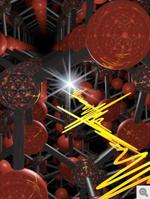
“Extremely short, configurable “femtosecond” pulses of light demonstrated by an international team could lead to future computers that run up to 100,000 times faster than today’s electronics. The researchers, including engineers at the University of Michigan, showed that …